History of Self-Learning Harnesses and State of the Union in 2026
From the history of agent harnesses to ten prompts with Codex on cruise control.
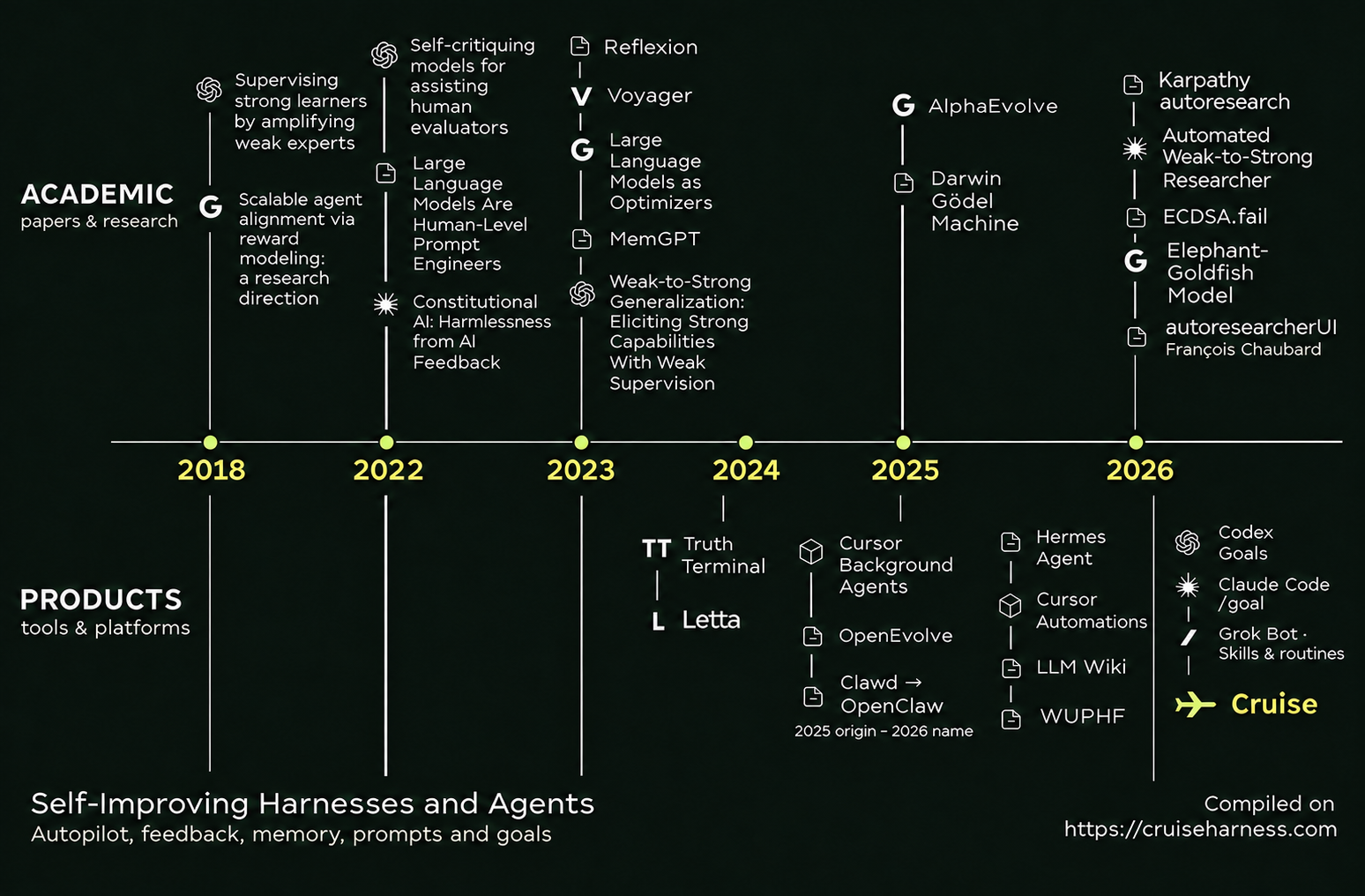
We gave Cruise a revenue goal for a fictional launch site. The first four prompts left the goal unchanged. On prompt 5, Cruise saved the price and picked up a rule of its own.
· 10 Codex prompts · 5 edits to Cruise.md
What makes a feedback loop?

An autopilot needs a way to decide what to do after each result. A feedback loop connects an attempt to an observation, then uses that observation to choose the next attempt. The useful signal might be a passing test, a better validation score, a reviewer’s correction, or evidence that a goal is still unfinished. The next prompt becomes useful when it responds to what happened.
In Andrej Karpathy’s autoresearch, an agent runs five-minute training experiments and keeps changes that improve a validation metric. Eigen Labs’ ECDSA.fail gives participants a public benchmark for comparing candidate quantum circuits. Anthropic’s automated alignment researcher uses Claude agents to propose experiments and iterate on whether a weaker model can supervise a stronger one. Each loop has a different way to judge the last attempt before deciding what to try next.
Two projects from 2025 show how far that feedback can reach. Google DeepMind’s AlphaEvolve generates code, tests it with automated evaluators, and uses the results to guide an evolutionary search for better algorithms. Sakana AI’s Darwin Gödel Machine modifies the coding agent itself, evaluates the resulting agents on programming tasks, and keeps an archive to explore further improvements. Both make the quality of the feedback central: another attempt becomes useful when its result can inform the next one.
A brief history of harnesses
In YC Paper Club’s Why the Harness Matters More Than the Model (7:13), François Chaubard traces how the machinery around a language model grew. His overview groups ideas by capability rather than strict chronology. These are some of its milestones, with dates checked against the original research.
- From text generation to richer prompts. Chaubard starts with a GPT-2-era generation loop: produce tokens until the sequence ends. GPT-3’s few-shot learning (2020) showed how examples in context could guide a task without updating model weights. Chain-of-thought prompting (2022) used demonstrations of intermediate steps to improve reasoning performance.
- Tools connect the model to an environment. WebGPT (2021) used a browsing environment to gather supporting references. Toolformer (2023) trained a model to use external APIs. The surrounding system can execute an action and return its result as context for another model call. InterCode (2023) made interactive coding with execution feedback a benchmarkable environment.
- Memory and skills carry work forward. MemGPT (2023) managed information across memory tiers beyond a single context window. Voyager (2023) accumulated executable Minecraft skills that could be retrieved and reused.
- Feedback changes the next attempt. ReAct (2022) interleaved reasoning and actions. Self-Refine (2023) iterated through generated feedback and revisions, while Reflexion (2023) retained verbal reflections for later trials. These are different ways to use feedback; they do not all require multiple agents.
- Delegate and process context programmatically. Recursive Language Models (2025) let a model inspect long inputs through code and recursively call models on smaller pieces, dividing work beyond a single context window.
- The harness becomes something to improve. DSPy (2023) made language-model pipelines and their prompts amenable to systematic optimization. The Darwin Gödel Machine (2025) explored changes to an agent’s own code, evaluating candidates and keeping an archive. Chaubard discusses this shift in the talk’s self-improving harnesses segment (14:11). Later, he introduces Continual Harness (2026), which adapts prompts, skills, subagents, and memory during an ongoing run.
His own autoresearcherUI brings several of these ideas together: experiments feed council reviews, lessons inform the idea queue, and a PI agent follows up on progress. The demo begins at 4:27.
We’re working on Cruise, which applies a narrower loop to existing Codex chats: read what happened, choose a useful next prompt, and retain guidance in Cruise.md.
Systems from the Paper Club talk
Beyond the research milestones, the talk introduces tools that turn these ideas into everyday agent workflows.
- gstack packages specialist workflows for Claude Code, including planning, review, and browser QA. Chaubard mentions it at 13:04.
- Prime Agent combines a persistent code interpreter, recursive subagents, and retained histories, memories, skills, and prompts. Seth Karten’s presentation starts at 18:35.
- OpenJarvis separates personal AI into Intelligence, Engine, Agents, Tools & Memory, and Learning. Its research uses cloud models to improve configurations that then run on-device. Jon Saad-Falcon’s presentation starts at 37:30.
- QM is YC’s shared agent harness for work, available through Slack and a web interface, with personal contexts, files, scheduled jobs, and sandboxes. The demo starts at 45:58; at 57:33, the presenters describe experimenting with time and token budgets to keep agents working on goals instead of stopping early.
Recursive self-improvement (RSI)
RSI gives this history a larger ambition: improvements to a system help it make further improvements. In the strongest version, AI designs and develops its own more capable successors. That ambition has older roots. Jürgen Schmidhuber’s Gödel Machines (2003) described a theoretical system that rewrites its software after proving a change will improve its objective. The Darwin Gödel Machine later explored an empirical route, testing changes to an agent’s code. In 2026, Sakana AI’s MASS: Recursive Self-Improvement through Multi-Agent Self-Supervision studied a loop that improves team workflows, trains the shared model on selected executions, and uses the updated model in the next round.
It helps to name what is changing: the prompt, the memory, the harness around the model, or the model itself. Cruise’s automatic follow-ups and evolving Cruise.md operate at the prompt and memory level. That does not establish model-level RSI. In When AI builds itself, Anthropic distinguishes carrying out a human-supplied goal from choosing which goals are worth pursuing, and describes fully autonomous successor development as an open possibility. For every version of the loop, the practical question remains: what evidence shows that the change made the system better?
What survives the next prompt?
Earlier research explored how human guidance could support increasingly capable systems. In 2018, Iterated Amplification combined solutions to easier subproblems to build supervision for harder ones. In 2022, Anthropic’s Constitutional AI used written principles to guide self-critiques, revisions, and learning from AI feedback. They established useful ideas about oversight and durable guidance that help frame today’s agent loops.
The prompts themselves became something a model could improve. In 2022, Automatic Prompt Engineer (APE) generated candidate instructions and selected them using evaluated task performance. In 2023, Optimization by PROmpting (OPRO) put previous solutions and their scores into the next prompt, asking the model to propose better candidates. Applied to prompt optimization, this made the instruction part of the feedback loop too.
GEPA: learning by rewriting prompts
GEPA: Reflective Prompt Evolution Can Outperform Reinforcement Learning (Agrawal et al., first submitted July 25, 2025) made this loop concrete for systems with one or more language-model prompts. GEPA stands for Genetic-Pareto. It reads execution traces, including reasoning, tool calls, and tool outputs, alongside evaluation feedback. A model reflects on what went wrong, proposes revised instructions, and tests those candidates. The search keeps prompts that work well on different examples, rather than repeatedly editing only one overall winner; it can also merge complementary improvements.
The underlying model weights stay fixed. What changes is the system’s written guidance, measured against a task evaluator. For this history, GEPA connects prompt optimization to the broader idea of a harness that learns from its runs. Its evaluation-driven search offers a useful comparison for evolving a saved prompt such as Cruise.md; editing that file alone does not establish the measured improvement that GEPA tests for.
In 2023, Voyager explored Minecraft by choosing new challenges, learning from execution feedback, and saving working code in a reusable skill library. That same year, Reflexion showed how an agent could write reflections on task feedback and carry those notes into later attempts. Together, they offer two useful ideas for an autopilot: choosing the next task and preserving something learned from the last one.
Truth Terminal grew out of Andy Ayrey’s 2024 Infinite Backrooms experiment, where language models had open-ended conversations with one another. Ayrey trained Truth Terminal on related conversations and gave it a Twitter account. Its posts drew a following and inspired meme coins created by other people. For me, its legacy is that it made agent feedback visible in public. People could react to what the agent posted, and those reactions raised questions about who stewards an agent and the resources that accumulate around it. Truth Collective’s account
OpenClaw started as Peter Steinberger’s WhatsApp relay and went through the names Clawd and Moltbot before becoming a personal agent platform that runs on your machine. It keeps durable decisions in MEMORY.md and working notes in dated Markdown files. Nous Research’s Hermes Agent also keeps memory across sessions and can turn a workflow it figured out into a reusable skill. Those files give the next session something concrete to build on. OpenClaw’s origin · OpenClaw’s memory · Hermes memory and skills
In Karpathy’s LLM Wiki, an agent keeps the source material and maintains a separate set of linked Markdown pages. New evidence can change an existing page or surface a contradiction. On Hacker News, the maker of WUPHF described a related approach that uses Markdown and Git for a shared wiki. Agents draft notes and reviewers decide what belongs in the wiki, with Git recording the edits. LLM Wiki · WUPHF on Hacker News
Google’s Elephant-Goldfish Model uses a long-running session, the elephant, to draft a specification. Fresh sessions, the goldfish, review the draft and its references without seeing the earlier chat. They can spot assumptions that made sense in the conversation but never made it onto the page. Elephant-Goldfish Model
Memory also needs a way to outlast the current context window. MemGPT explored that in 2023 by letting an agent move information between memory tiers, drawing on ideas from operating systems. The work continued through the Letta agent framework. For Cruise, the relevant lesson is continuity: a later prompt should be able to use the goal and useful lessons saved in Cruise.md.
These ideas now appear in everyday products. Cursor’s Background Agents (2025) brought asynchronous coding to remote environments; its Automations (2026) launch cloud agents on schedules or events. Grok Bot’s skills and routines (2026) turn a successful workflow into reusable instructions, then run it on a schedule or event. Codex Goals (2026) keeps an objective active across turns until it reaches a supported stopping condition. Claude Code’s /goal (2026) checks a completion condition after each turn and continues when it is unmet. Cruise works at the Mac menu bar, following selected Codex chats and carrying their guidance in Cruise.md.
Another example is Vorflux, from Rippling cofounder and former CTO Prasanna Sankar. Its engineering harness breaks work into tasks and repeats a build, judge, and fix loop. On November 5, 2026, Sankar announced Vorflux 2.0 as Slack coworkers that own a goal and work around the clock. That announcement points toward agents carrying an ongoing responsibility, with the product’s public documentation providing more detail on its engineering and review loops.
YC’s Summer and Fall 2026 directories show more companies building the machinery around an agent. Jcode’s Auto-poke checks unfinished work and prompts the agent to continue. Its self-development mode can edit, build, test, and reload its own implementation. Hoplite coordinates cloud coding agents and brings them back to CI failures and review comments. Acyclic Labs splits work into sandboxed agent branches and combines their results. These are close relatives of the orchestration offered by Conductor and Orchestrator: keeping work moving across agents, tasks, and checks.
A related group concentrates on what the next run can learn. Glen retrieves prior sessions and distills shared skills. Grep AI describes a self-improving harness that turns repeated reasoning steps into workflows and code. Papaya proposes fixes from agent traces and monitors the results. For research itself, Autoresearch, Inc. runs evaluated improvement campaigns, while rekursiv.ai aims to use AI scientists’ discoveries to accelerate their next experiments. The shared opportunity is to make experience useful after the current task ends.
Cruise applies that feedback pattern to an existing Codex chat. The completed reply helps Cruise choose the next prompt, and a saved goal in Cruise.md gives those prompts a direction. Submitting a prompt sends a specific task to Codex, like “Add a sponsorship inquiry form.” Saving a goal gives Cruise guidance it can reuse across prompts, like “Explore revenue while keeping ordinary submissions free.” The checkbox controls which chats get automatic follow-ups.
Why start building Cruise Harness
The idea came from a recurring bottleneck: models were getting remarkably good, and running several agents in parallel was becoming practical. A frontier lab subscription with enough capacity, or a workspace for orchestrating agents such as Conductor, could keep more work moving at once. Human attention was often the thing holding it up.
Each reply still needed review, another prompt, an approval, an answer, or a nudge back toward the intended direction. Those small interventions add up. More of that attention belongs on direction and judgment, with less time spent typing the next useful follow-up.
That is why I started working on Cruise. The wish can be as simple as taking a nap or leaving a project moving overnight: let Codex keep building, let Cruise keep prompting, then review the progress later. Cruise reads each completed response and chooses the next prompt, guided by the conversation and an optional goal.
The loop is simple: send a prompt, let Codex work and raise questions, review what happened, then use that guidance to choose the next prompt. Cruise takes on the routine follow-ups while leaving room for human steering. The aim is to keep useful work moving between those moments.
Next come the product decisions behind that loop and the results from a simple sample Codex project: ten prompts, ten passes, with the changes and lessons visible along the way.
When we put Codex on cruise control for 10 prompts
Launchboard was a blank local prototype for a Product Hunt clone. The first line of its Cruise.md set a broad objective of making revenue. People would still discover, vote on, and submit products for free. Paid placements would be clearly labelled and sit outside the organic rankings. The experiment used fictional data and stopped at a local prototype.
Cruise.md
# Goal

Make revenue from Launchboard, a Product Hunt clone website where people discover and upvote new products.

## Boundaries

- Keep discovery, voting, and ordinary submissions free. Clearly label any paid placement and keep it out of organic rankings.
- Work on a local prototype with fictional data. No deployment, real payments, outreach, or claims of actual revenue.
We seeded a conversation and sent ten prompts to Codex in an isolated fixture. Cruise’s planner read each completed reply alongside the saved goal. It could draft the next prompt and optionally revise Cruise.md. The fixture stored the chat in Codex-shaped SQLite tables and a rollout log, then replayed it through separate CLI calls for work and planning.
Prompt 1 · Built the discovery page
Prompt 01 · Seed promptBuild a small, usable local discovery page for Launchboard with fictional product launches, votes, and free submission access. Make it possible to add a clearly labelled monetization surface separately. Keep this to one concrete increment.
Build a small, usable local discovery page for Launchboard with fictional product launches, votes, and free submission access. Make it possible to add a clearly labelled monetization surface separately. Keep this to one concrete increment.
Built [Launchboard](./index.html) with fictional launches, ranked votes, reversible upvoting, and free submissions. A separate sponsor placeholder allows future labelled paid placements. Local syntax and behavior checks passed. Changes reset on refresh. No network access, deployment, or payments.
The first prompt made Launchboard usable. Codex built a discovery page with fictional products, reversible upvotes, and free submissions. It set aside a spot for a sponsor.
Prompt 1 · Cruise.md · Unchanged
Plain text snapshots
Before prompt 1
# Goal

Make revenue from Launchboard, a Product Hunt clone website where people discover and upvote new products.

## Boundaries

- Keep discovery, voting, and ordinary submissions free. Clearly label any paid placement and keep it out of organic rankings.
- Work on a local prototype with fictional data. No deployment, real payments, outreach, or claims of actual revenue.
After prompt 1
# Goal

Make revenue from Launchboard, a Product Hunt clone website where people discover and upvote new products.

## Boundaries

- Keep discovery, voting, and ordinary submissions free. Clearly label any paid placement and keep it out of organic rankings.
- Work on a local prototype with fictional data. No deployment, real payments, outreach, or claims of actual revenue.
Prompt 2 · Built the sponsorship flow
Prompt 02 · Cruise → CodexTurn Launchboard’s existing sponsor placeholder into one usable local sponsorship demo. Add a clearly labelled sponsored card outside the organic rankings and a CTA that opens a short sponsorship inquiry form. Use fictional sample details and show a local confirmation explicitly stating that nothing was sent or purchased; do not collect payment or imply agreed pricing or actual revenue. Keep discovery, voting, and ordinary submissions free. Match the existing page design and check the new interaction locally.
Turn Launchboard’s existing sponsor placeholder into one usable local sponsorship demo. Add a clearly labelled sponsored card outside the organic rankings and a CTA that opens a short sponsorship inquiry form. Use fictional sample details and show a local confirmation explicitly stating that nothing was sent or purchased; do not collect payment or imply agreed pricing or actual revenue. Keep discovery, voting, and ordinary submissions free. Match the existing page design and check the new interaction locally.
Added a clearly labelled fictional sponsored card outside organic rankings, matching the existing design. Its CTA opens a short inquiry form with fictional sample details. Confirmation explicitly states nothing was sent or purchased, no pricing was agreed, and no revenue was recorded. Community features remain free. JavaScript syntax and local simulated interaction checks passed. No network access or deployment.
The planner picked up that placeholder and made it the second assignment. Codex turned it into a labelled sponsored card and built an inquiry form that could be tried locally.
Prompt 2 · Cruise.md · Unchanged
Plain text snapshots
Before prompt 2
# Goal

Make revenue from Launchboard, a Product Hunt clone website where people discover and upvote new products.

## Boundaries

- Keep discovery, voting, and ordinary submissions free. Clearly label any paid placement and keep it out of organic rankings.
- Work on a local prototype with fictional data. No deployment, real payments, outreach, or claims of actual revenue.
After prompt 2
# Goal

Make revenue from Launchboard, a Product Hunt clone website where people discover and upvote new products.

## Boundaries

- Keep discovery, voting, and ordinary submissions free. Clearly label any paid placement and keep it out of organic rankings.
- Work on a local prototype with fictional data. No deployment, real payments, outreach, or claims of actual revenue.
Prompt 3 · Added a placement preview
Prompt 03 · Cruise → CodexExtend the existing local sponsorship inquiry demo with a placement preview. Inspect the current form and reuse its fictional product details to let someone preview how their sponsored card would appear before submitting the inquiry. Allow editing a product name, short description, and CTA label, using fictional defaults, and update the preview locally. Keep the preview clearly labelled as fictional sponsored content outside organic rankings. Preserve the existing confirmation and free community features; add no network requests, payments, or pricing claims. Match the current design and check the preview interaction locally.
Extend the existing local sponsorship inquiry demo with a placement preview. Inspect the current form and reuse its fictional product details to let someone preview how their sponsored card would appear before submitting the inquiry. Allow editing a product name, short description, and CTA label, using fictional defaults, and update the preview locally. Keep the preview clearly labelled as fictional sponsored content outside organic rankings. Preserve the existing confirmation and free community features; add no network requests, payments, or pricing claims. Match the current design and check the preview interaction locally.
Added a live placement preview with editable fictional product name, description, and CTA label. It’s clearly labelled sponsored content outside organic rankings. Existing confirmation and free community features remain intact. Local syntax and simulated interaction checks passed. No network requests, payments, or pricing claims added.
In response to prompt 3, sponsors could edit the fictional product name, description, and button label and see the placement update as they typed.
Prompt 3 · Cruise.md · Unchanged
Plain text snapshots
Before prompt 3
# Goal

Make revenue from Launchboard, a Product Hunt clone website where people discover and upvote new products.

## Boundaries

- Keep discovery, voting, and ordinary submissions free. Clearly label any paid placement and keep it out of organic rankings.
- Work on a local prototype with fictional data. No deployment, real payments, outreach, or claims of actual revenue.
After prompt 3
# Goal

Make revenue from Launchboard, a Product Hunt clone website where people discover and upvote new products.

## Boundaries

- Keep discovery, voting, and ordinary submissions free. Clearly label any paid placement and keep it out of organic rankings.
- Work on a local prototype with fictional data. No deployment, real payments, outreach, or claims of actual revenue.
Prompt 4 · Added the inquiry review
Prompt 04 · Cruise → CodexExtend the local sponsorship demo with a review summary created when “Preview inquiry locally” is submitted. Show a snapshot of the fictional company, sample contact, product name, description, and CTA label so someone can review the complete inquiry together. Use in-memory state that resets on refresh. If fields change afterward, mark the summary as outdated until it is regenerated, while keeping the existing live placement preview working. Preserve the confirmation that nothing was sent or purchased, no pricing was agreed, and no revenue was recorded. Match the current design, keep community features free and sponsored content outside organic rankings, and add no network requests, payments, or deployment. Check the new summary interaction locally.
Extend the local sponsorship demo with a review summary created when “Preview inquiry locally” is submitted. Show a snapshot of the fictional company, sample contact, product name, description, and CTA label so someone can review the complete inquiry together. Use in-memory state that resets on refresh. If fields change afterward, mark the summary as outdated until it is regenerated, while keeping the existing live placement preview working. Preserve the confirmation that nothing was sent or purchased, no pricing was agreed, and no revenue was recorded. Match the current design, keep community features free and sponsored content outside organic rankings, and add no network requests, payments, or deployment. Check the new summary interaction locally.
Added an in-memory inquiry summary showing all five fields. Edits mark the snapshot outdated; submitting again regenerates it. The live placement preview and existing confirmation remain intact. JavaScript syntax and simulated interaction checks passed. Community features remain free; no network requests, payments, or deployment were added.
Prompt 4 asked Codex to add a review screen that captured all five inquiry fields. Changing a field after review marked that snapshot outdated. Each result gave the planner a specific next step. The first four prompts left Cruise.md unchanged.
Prompt 4 · Cruise.md · Unchanged
Plain text snapshots
Before prompt 4
# Goal

Make revenue from Launchboard, a Product Hunt clone website where people discover and upvote new products.

## Boundaries

- Keep discovery, voting, and ordinary submissions free. Clearly label any paid placement and keep it out of organic rankings.
- Work on a local prototype with fictional data. No deployment, real payments, outreach, or claims of actual revenue.
After prompt 4
# Goal

Make revenue from Launchboard, a Product Hunt clone website where people discover and upvote new products.

## Boundaries

- Keep discovery, voting, and ordinary submissions free. Clearly label any paid placement and keep it out of organic rankings.
- Work on a local prototype with fictional data. No deployment, real payments, outreach, or claims of actual revenue.
Prompt 5 · The owner sets the price
Prompt 05 · Cruise → CodexConnect the completed sponsorship inquiry review to the page’s sponsored card with an explicit “Preview this placement on the page” action. Use the current reviewed snapshot to update only the separate fictional sponsored card in memory, and provide a reset to its original sample content. Disable this action when the summary is outdated until the inquiry is regenerated. Clearly describe the result as a local fictional placement preview; preserve the confirmation that nothing was sent or purchased, no pricing was agreed, and no revenue was recorded. Keep community features free and organic rankings unchanged. Add no network requests, payments, persistence, or deployment. Match the existing design and check the apply, outdated-summary, and reset interactions locally.
Connect the completed sponsorship inquiry review to the page’s sponsored card with an explicit “Preview this placement on the page” action. Use the current reviewed snapshot to update only the separate fictional sponsored card in memory, and provide a reset to its original sample content. Disable this action when the summary is outdated until the inquiry is regenerated. Clearly describe the result as a local fictional placement preview; preserve the confirmation that nothing was sent or purchased, no pricing was agreed, and no revenue was recorded. Keep community features free and organic rankings unchanged. Add no network requests, payments, persistence, or deployment. Match the existing design and check the apply, outdated-summary, and reset interactions locally.
Added reviewed-snapshot placement apply and reset. Outdated summaries disable apply until regenerated. The only offer shown is Featured Launch at $49 for seven days. Syntax and simulated local interaction checks passed for apply, stale-summary blocking, and reset. Organic launches and free community features remain unchanged. Nothing was sent or purchased; no pricing was agreed or revenue recorded. No network, persistence, payments, or deployment added.
We introduced a product decision midway through the run. Launchboard would have one paid offer, Featured Launch at $49 for seven days. That would be the only tier. Codex put the offer on the page and let a sponsor apply a reviewed preview to the sample card, then reset it. An outdated review blocked the apply action until the sponsor reviewed it again.
New decision from the product owner: the only paid offer for this prototype is a clearly labelled Featured Launch at $49 for seven days. Do not introduce subscriptions or additional price tiers. Continue the useful part of the planned work within this scope.
This was the first edit to Cruise.md. The planner saved the offer and added a Completed section. It also saved “no persistence” under Boundaries. That phrase came from an automated prompt that asked Codex to keep one preview in memory. Saving it as a boundary gave a choice about one task the force of a rule for every later task.
Prompt 5 · Cruise.md · Modified
Raw Git diff
diff --git a/before/Cruise.md b/after/Cruise.md
index 017e547..0feedb5 100644
--- a/before/Cruise.md
+++ b/after/Cruise.md
@@ -5,4 +5,9 @@ Make revenue from Launchboard, a Product Hunt clone website where people discove
 ## Boundaries

 - Keep discovery, voting, and ordinary submissions free. Clearly label any paid placement and keep it out of organic rankings.
-- Work on a local prototype with fictional data. No deployment, real payments, outreach, or claims of actual revenue.
+- The only paid offer for this prototype is Featured Launch at $49 for seven days. Do not introduce subscriptions or additional price tiers.
+- Work on a local prototype with fictional data. No network requests, persistence, deployment, real payments, outreach, or claims of actual revenue.
+
+## Completed
+
+The local discovery page supports fictional launches, reversible voting, and free submissions. The sponsorship demo includes editable placement previews, a reviewed inquiry snapshot, outdated-summary blocking, applying the reviewed snapshot to the separate sponsored card, and resetting its sample content. These interactions passed local checks. The demo explicitly states that nothing was sent or purchased, no pricing was agreed, and no revenue was recorded.
\ No newline at end of file
Prompt 6 · Added campaign dates
Prompt 06 · Cruise → CodexAdd a local campaign-date preview for the existing Featured Launch offer. The reviewed-snapshot apply, outdated-summary blocking, and reset interactions are already complete; build on them. Let the fictional sponsor choose a start date, defaulting to today in the browser’s local timezone, and show the seven-day run as that date through six calendar days later. Include the dates and fixed $49 total in the inquiry review and applied sponsored card. Changing the date must mark the reviewed snapshot outdated. Reset must restore the original sample placement. Describe dates as an illustrative schedule with no reservation or availability guarantee. Keep the single offer, free community features, organic rankings, and existing no-purchase/no-revenue confirmation intact. Use memory only; add no network requests, payments, persistence, or deployment. Match the existing design and check date calculation across month boundaries plus review, apply, and reset locally.
Add a local campaign-date preview for the existing Featured Launch offer. The reviewed-snapshot apply, outdated-summary blocking, and reset interactions are already complete; build on them. Let the fictional sponsor choose a start date, defaulting to today in the browser’s local timezone, and show the seven-day run as that date through six calendar days later. Include the dates and fixed $49 total in the inquiry review and applied sponsored card. Changing the date must mark the reviewed snapshot outdated. Reset must restore the original sample placement. Describe dates as an illustrative schedule with no reservation or availability guarantee. Keep the single offer, free community features, organic rankings, and existing no-purchase/no-revenue confirmation intact. Use memory only; add no network requests, payments, persistence, or deployment. Match the existing design and check date calculation across month boundaries plus review, apply, and reset locally.
Added a local campaign-date preview defaulting to browser-local today. Review and applied cards show seven inclusive calendar days and $49 total, labelled illustrative with no reservation or availability guarantee. Date edits invalidate review; reset restores the original sample. Syntax and simulated interaction checks passed, including month/year boundaries and leap years. Free community features and confirmation remain intact. No network, persistence, payments, or deployment added.
Prompt 6 put dates on the seven-day offer. A fictional sponsor could choose a start date and see the inclusive run and $49 total in the review and applied card.
Prompt 6 · Cruise.md · Modified
Raw Git diff
diff --git a/before/Cruise.md b/after/Cruise.md
index 0feedb5..cab8a02 100644
--- a/before/Cruise.md
+++ b/after/Cruise.md
@@ -10,4 +10,4 @@ Make revenue from Launchboard, a Product Hunt clone website where people discove

 ## Completed

-The local discovery page supports fictional launches, reversible voting, and free submissions. The sponsorship demo includes editable placement previews, a reviewed inquiry snapshot, outdated-summary blocking, applying the reviewed snapshot to the separate sponsored card, and resetting its sample content. These interactions passed local checks. The demo explicitly states that nothing was sent or purchased, no pricing was agreed, and no revenue was recorded.
\ No newline at end of file
+The local discovery page supports fictional launches, reversible voting, and free submissions. The sponsorship demo includes editable placement previews, a reviewed inquiry snapshot, outdated-summary blocking, applying the reviewed snapshot to the separate sponsored card, and resetting its sample content. Campaign dates default to browser-local today and show seven inclusive calendar days with the fixed $49 total in the review and applied card. Date edits invalidate the review; schedules are illustrative with no reservation or availability guarantee. These interactions and date calculations across month/year boundaries and leap years passed local checks. The demo explicitly states that nothing was sent or purchased, no pricing was agreed, and no revenue was recorded.
\ No newline at end of file
Prompt 7 · Added simulated performance
Prompt 07 · Cruise → CodexAdd a small simulated performance panel for the existing Featured Launch placement so a fictional sponsor can understand how results would be presented. Provide explicit “Simulate impression” and “Simulate click” controls, showing impressions, clicks, and calculated click-through rate. Treat a simulated click as also adding one impression so counts remain consistent; show 0% when there are no impressions. Clearly label all metrics as simulated, with no actual audience or performance claims. Keep counters in memory and reset them when a reviewed placement is applied or the sample placement is restored. Preserve the completed date preview, review and apply behavior, single $49 seven-day offer, free community features, organic rankings, and existing confirmation. Match the current design, add no network requests, persistence, payments, or deployment, and check the new counter and reset behavior locally.
Add a small simulated performance panel for the existing Featured Launch placement so a fictional sponsor can understand how results would be presented. Provide explicit “Simulate impression” and “Simulate click” controls, showing impressions, clicks, and calculated click-through rate. Treat a simulated click as also adding one impression so counts remain consistent; show 0% when there are no impressions. Clearly label all metrics as simulated, with no actual audience or performance claims. Keep counters in memory and reset them when a reviewed placement is applied or the sample placement is restored. Preserve the completed date preview, review and apply behavior, single $49 seven-day offer, free community features, organic rankings, and existing confirmation. Match the current design, add no network requests, persistence, payments, or deployment, and check the new counter and reset behavior locally.
Added a clearly labelled simulated performance panel with impression/click controls and CTR. Each click adds an impression; applying or restoring a placement resets counters. Local syntax and simulated interaction checks passed, including stale-review blocking and resets. Existing offer, dates, confirmation, and free community features remain intact. No network, persistence, payments, or deployment added.
Prompt 7 added simulated impressions, clicks, and click-through rate. The counters reset when the sponsor applied a new placement or restored the sample.
Prompt 7 · Cruise.md · Modified
Raw Git diff
diff --git a/before/Cruise.md b/after/Cruise.md
index cab8a02..f9fdde2 100644
--- a/before/Cruise.md
+++ b/after/Cruise.md
@@ -10,4 +10,4 @@ Make revenue from Launchboard, a Product Hunt clone website where people discove

 ## Completed

-The local discovery page supports fictional launches, reversible voting, and free submissions. The sponsorship demo includes editable placement previews, a reviewed inquiry snapshot, outdated-summary blocking, applying the reviewed snapshot to the separate sponsored card, and resetting its sample content. Campaign dates default to browser-local today and show seven inclusive calendar days with the fixed $49 total in the review and applied card. Date edits invalidate the review; schedules are illustrative with no reservation or availability guarantee. These interactions and date calculations across month/year boundaries and leap years passed local checks. The demo explicitly states that nothing was sent or purchased, no pricing was agreed, and no revenue was recorded.
\ No newline at end of file
+The local discovery page supports fictional launches, reversible voting, and free submissions. The sponsorship demo includes editable placement previews, a reviewed inquiry snapshot, outdated-summary blocking, applying the reviewed snapshot to the separate sponsored card, and resetting its sample content. Campaign dates default to browser-local today and show seven inclusive calendar days with the fixed $49 total in the review and applied card. Date edits invalidate the review; schedules are illustrative with no reservation or availability guarantee. A clearly labelled simulated performance panel shows impressions, clicks, and CTR; each simulated click also adds an impression, and applying or restoring a placement resets the counters. These interactions, counter resets, and date calculations across month/year boundaries and leap years passed local checks. The demo explicitly states that nothing was sent or purchased, no pricing was agreed, and no revenue was recorded.
\ No newline at end of file
Prompt 8 · Calculated potential revenue
Prompt 08 · Cruise → CodexAdd a small local revenue scenario calculator for the existing Featured Launch offer. Let someone enter a hypothetical number of seven-day placements and show potential gross revenue as that count × $49, defaulting to one placement. Accept only nonnegative whole numbers and handle empty or invalid input clearly. Label the result as a fictional planning scenario, with no sales, inventory availability, or actual revenue implied. Keep it separate from the sponsor’s simulated performance metrics and organic rankings. Preserve the single offer, free community features, completed inquiry/date/apply/reset interactions, and existing confirmations. Use in-memory state only, match the current design, and check the calculation and input handling locally. Add no network requests, persistence, payments, outreach, or deployment.
Add a small local revenue scenario calculator for the existing Featured Launch offer. Let someone enter a hypothetical number of seven-day placements and show potential gross revenue as that count × $49, defaulting to one placement. Accept only nonnegative whole numbers and handle empty or invalid input clearly. Label the result as a fictional planning scenario, with no sales, inventory availability, or actual revenue implied. Keep it separate from the sponsor’s simulated performance metrics and organic rankings. Preserve the single offer, free community features, completed inquiry/date/apply/reset interactions, and existing confirmations. Use in-memory state only, match the current design, and check the calculation and input handling locally. Add no network requests, persistence, payments, outreach, or deployment.
Added a separate fictional planning calculator: defaults to one placement and shows count × $49. Empty or invalid input displays guidance and clears the total. Syntax and local interaction checks passed for zero, multiplication, large counts, invalid input, and recovery. Existing features remain intact. No network, persistence, payments, outreach, or deployment added.
In response to prompt 8, Codex built a separate calculator for hypothetical gross revenue. Enter a placement count and Launchboard multiplies it by $49.
Prompt 8 · Cruise.md · Modified
Raw Git diff
diff --git a/before/Cruise.md b/after/Cruise.md
index f9fdde2..f4139b0 100644
--- a/before/Cruise.md
+++ b/after/Cruise.md
@@ -10,4 +10,4 @@ Make revenue from Launchboard, a Product Hunt clone website where people discove

 ## Completed

-The local discovery page supports fictional launches, reversible voting, and free submissions. The sponsorship demo includes editable placement previews, a reviewed inquiry snapshot, outdated-summary blocking, applying the reviewed snapshot to the separate sponsored card, and resetting its sample content. Campaign dates default to browser-local today and show seven inclusive calendar days with the fixed $49 total in the review and applied card. Date edits invalidate the review; schedules are illustrative with no reservation or availability guarantee. A clearly labelled simulated performance panel shows impressions, clicks, and CTR; each simulated click also adds an impression, and applying or restoring a placement resets the counters. These interactions, counter resets, and date calculations across month/year boundaries and leap years passed local checks. The demo explicitly states that nothing was sent or purchased, no pricing was agreed, and no revenue was recorded.
\ No newline at end of file
+The local discovery page supports fictional launches, reversible voting, and free submissions. The sponsorship demo includes editable placement previews, a reviewed inquiry snapshot, outdated-summary blocking, applying the reviewed snapshot to the separate sponsored card, and resetting its sample content. Campaign dates default to browser-local today and show seven inclusive calendar days with the fixed $49 total in the review and applied card. Date edits invalidate the review; schedules are illustrative with no reservation or availability guarantee. A clearly labelled simulated performance panel shows impressions, clicks, and CTR; each simulated click also adds an impression, and applying or restoring a placement resets the counters. A separate fictional revenue scenario calculator defaults to one placement and calculates a nonnegative whole-number placement count × $49; empty or invalid input clears the total and shows guidance. These interactions, calculations, input handling, counter resets, and date boundaries passed local checks. The demo explicitly states that nothing was sent or purchased, no pricing was agreed, and no revenue was recorded.
\ No newline at end of file
Prompt 9 · Connected submissions to sponsorship
Prompt 09 · Cruise → CodexAdd a local path from a successfully submitted fictional product to the existing Featured Launch demo. In the free submission confirmation, offer an optional “Preview a Featured Launch” action that opens the sponsorship form with that product’s name and description prefilled. Keep submission free and complete regardless of whether this action is used. Reuse the existing $49 seven-day offer and review flow; invalidate any older inquiry snapshot when prefilling so it cannot apply stale details. Preserve dates, apply/reset behavior, simulated metrics, the completed revenue calculator, and existing fictional/no-purchase confirmations. Use memory only, match the current design, and check the submission-to-preview interaction locally. Add no network requests, persistence, payments, outreach, or deployment.
Add a local path from a successfully submitted fictional product to the existing Featured Launch demo. In the free submission confirmation, offer an optional “Preview a Featured Launch” action that opens the sponsorship form with that product’s name and description prefilled. Keep submission free and complete regardless of whether this action is used. Reuse the existing $49 seven-day offer and review flow; invalidate any older inquiry snapshot when prefilling so it cannot apply stale details. Preserve dates, apply/reset behavior, simulated metrics, the completed revenue calculator, and existing fictional/no-purchase confirmations. Use memory only, match the current design, and check the submission-to-preview interaction locally. Add no network requests, persistence, payments, outreach, or deployment.
Added optional “Preview a Featured Launch” to the free submission confirmation. It prefills the submitted product’s name and description and invalidates older reviews until regenerated. Syntax and simulated local interaction checks passed for submission, prefill, stale-review blocking, apply, and reset. Existing dates, metrics, calculator, and confirmations remain intact. No network, persistence, payments, outreach, or deployment added.
Prompt 9 connected the free submission flow to the sponsor preview. After submitting a product, a maker could optionally open a Featured Launch preview with their product name and description already filled in. After each of these four prompts, the planner added the milestone to Completed. The price and the extra persistence rule carried forward together.
Prompt 9 · Cruise.md · Modified
Raw Git diff
diff --git a/before/Cruise.md b/after/Cruise.md
index f4139b0..866c991 100644
--- a/before/Cruise.md
+++ b/after/Cruise.md
@@ -10,4 +10,4 @@ Make revenue from Launchboard, a Product Hunt clone website where people discove

 ## Completed

-The local discovery page supports fictional launches, reversible voting, and free submissions. The sponsorship demo includes editable placement previews, a reviewed inquiry snapshot, outdated-summary blocking, applying the reviewed snapshot to the separate sponsored card, and resetting its sample content. Campaign dates default to browser-local today and show seven inclusive calendar days with the fixed $49 total in the review and applied card. Date edits invalidate the review; schedules are illustrative with no reservation or availability guarantee. A clearly labelled simulated performance panel shows impressions, clicks, and CTR; each simulated click also adds an impression, and applying or restoring a placement resets the counters. A separate fictional revenue scenario calculator defaults to one placement and calculates a nonnegative whole-number placement count × $49; empty or invalid input clears the total and shows guidance. These interactions, calculations, input handling, counter resets, and date boundaries passed local checks. The demo explicitly states that nothing was sent or purchased, no pricing was agreed, and no revenue was recorded.
\ No newline at end of file
+The local discovery page supports fictional launches, reversible voting, and free submissions. The sponsorship demo includes editable placement previews, a reviewed inquiry snapshot, outdated-summary blocking, applying the reviewed snapshot to the separate sponsored card, and resetting its sample content. Campaign dates default to browser-local today and show seven inclusive calendar days with the fixed $49 total in the review and applied card. Date edits invalidate the review; schedules are illustrative with no reservation or availability guarantee. A clearly labelled simulated performance panel shows impressions, clicks, and CTR; each simulated click also adds an impression, and applying or restoring a placement resets the counters. A separate fictional revenue scenario calculator defaults to one placement and calculates a nonnegative whole-number placement count × $49; empty or invalid input clears the total and shows guidance. Free submission confirmation offers an optional “Preview a Featured Launch” action that opens the sponsorship form with the submitted product’s name and description prefilled and invalidates older inquiry snapshots. Submission remains free and complete independently. These interactions, calculations, input handling, counter resets, and date boundaries passed local checks. The demo explicitly states that nothing was sent or purchased, no pricing was agreed, and no revenue was recorded.
\ No newline at end of file
Prompt 10 · Followed the click
Prompt 10 · Cruise → CodexAdd a local visitor-facing destination preview for the Featured Launch so the sponsorship demo shows what happens after someone clicks a placement. Inspect the existing sponsored card and give its product CTA a fictional product-detail dialog showing the currently applied product name and description; keep sponsorship inquiry access as a separate, clearly named action. Use a simple fictional destination with no external links or purchase controls. Opening this destination should add one simulated click and impression through the existing metrics logic, with clear simulated labeling. Preserve reviewed-snapshot apply/reset, stale-review blocking, dates, the $49 seven-day offer, the submission-to-preview shortcut, the revenue calculator, and free community features. Match the current design, support keyboard opening and dismissal, and check the new interaction locally. Use memory only; add no network requests, persistence, payments, outreach, deployment, or actual-revenue claims.
Add a local visitor-facing destination preview for the Featured Launch so the sponsorship demo shows what happens after someone clicks a placement. Inspect the existing sponsored card and give its product CTA a fictional product-detail dialog showing the currently applied product name and description; keep sponsorship inquiry access as a separate, clearly named action. Use a simple fictional destination with no external links or purchase controls. Opening this destination should add one simulated click and impression through the existing metrics logic, with clear simulated labeling. Preserve reviewed-snapshot apply/reset, stale-review blocking, dates, the $49 seven-day offer, the submission-to-preview shortcut, the revenue calculator, and free community features. Match the current design, support keyboard opening and dismissal, and check the new interaction locally. Use memory only; add no network requests, persistence, payments, outreach, deployment, or actual-revenue claims.
Added a fictional product-detail dialog showing the currently applied placement. Opening it adds one simulated click and impression. Sponsorship inquiry remains a separate action. Native dialog controls support keyboard opening, Escape dismissal, and focus return. Syntax and simulated interaction checks passed for metrics, applied details, stale-review blocking, and reset. No network or persistence added.
The final prompt switched to the visitor’s view. Clicking the featured card opened a fictional product detail dialog and counted as one simulated click and impression. The planner read that result and proposed a follow-up about how to interpret those counts against the $49 fee. We stopped at ten prompts, with the tenth result in the conversation and the saved progress ending at prompt 9.
Prompt 10 · Cruise.md · Unchanged
Plain text snapshots
Before prompt 10
# Goal

Make revenue from Launchboard, a Product Hunt clone website where people discover and upvote new products.

## Boundaries

- Keep discovery, voting, and ordinary submissions free. Clearly label any paid placement and keep it out of organic rankings.
- The only paid offer for this prototype is Featured Launch at $49 for seven days. Do not introduce subscriptions or additional price tiers.
- Work on a local prototype with fictional data. No network requests, persistence, deployment, real payments, outreach, or claims of actual revenue.

## Completed

The local discovery page supports fictional launches, reversible voting, and free submissions. The sponsorship demo includes editable placement previews, a reviewed inquiry snapshot, outdated-summary blocking, applying the reviewed snapshot to the separate sponsored card, and resetting its sample content. Campaign dates default to browser-local today and show seven inclusive calendar days with the fixed $49 total in the review and applied card. Date edits invalidate the review; schedules are illustrative with no reservation or availability guarantee. A clearly labelled simulated performance panel shows impressions, clicks, and CTR; each simulated click also adds an impression, and applying or restoring a placement resets the counters. A separate fictional revenue scenario calculator defaults to one placement and calculates a nonnegative whole-number placement count × $49; empty or invalid input clears the total and shows guidance. Free submission confirmation offers an optional “Preview a Featured Launch” action that opens the sponsorship form with the submitted product’s name and description prefilled and invalidates older inquiry snapshots. Submission remains free and complete independently. These interactions, calculations, input handling, counter resets, and date boundaries passed local checks. The demo explicitly states that nothing was sent or purchased, no pricing was agreed, and no revenue was recorded.
After prompt 10
# Goal

Make revenue from Launchboard, a Product Hunt clone website where people discover and upvote new products.

## Boundaries

- Keep discovery, voting, and ordinary submissions free. Clearly label any paid placement and keep it out of organic rankings.
- The only paid offer for this prototype is Featured Launch at $49 for seven days. Do not introduce subscriptions or additional price tiers.
- Work on a local prototype with fictional data. No network requests, persistence, deployment, real payments, outreach, or claims of actual revenue.

## Completed

The local discovery page supports fictional launches, reversible voting, and free submissions. The sponsorship demo includes editable placement previews, a reviewed inquiry snapshot, outdated-summary blocking, applying the reviewed snapshot to the separate sponsored card, and resetting its sample content. Campaign dates default to browser-local today and show seven inclusive calendar days with the fixed $49 total in the review and applied card. Date edits invalidate the review; schedules are illustrative with no reservation or availability guarantee. A clearly labelled simulated performance panel shows impressions, clicks, and CTR; each simulated click also adds an impression, and applying or restoring a placement resets the counters. A separate fictional revenue scenario calculator defaults to one placement and calculates a nonnegative whole-number placement count × $49; empty or invalid input clears the total and shows guidance. Free submission confirmation offers an optional “Preview a Featured Launch” action that opens the sponsorship form with the submitted product’s name and description prefilled and invalidates older inquiry snapshots. Submission remains free and complete independently. These interactions, calculations, input handling, counter resets, and date boundaries passed local checks. The demo explicitly states that nothing was sent or purchased, no pricing was agreed, and no revenue was recorded.
Explore the files
Use the explorer after each prompt to compare Cruise.md or one of the three prototype files. The comparison uses the captured files from before and after Codex handled that prompt. Edits to Cruise.md also have a plain Git diff generated from the two saved versions.
Each export includes the prototype files, Cruise.md, and a prompt-notes.md with the prompt, reply, and changed files.
Submit your own results
Launchboard is open source under the MIT license. Its starting point is just one simple Markdown file: launchboard/Cruise.md. It describes the product goal and boundaries. There is no starter application code.
I’d love to see how ten prompts can transform that starting point. Give the Markdown to your self-learning harness and let it choose and submit all ten work prompts—including the first. You don’t write the prompts or reuse Cruise’s sequence. After each response, the harness decides what to try next and what to remember. Stop after ten completed work passes, and show what changed.
Fork the repository and open a pull request containing the actual prompts in prompts/<your-harness>/ and the final source, run instructions, and notes in results/<your-harness>/. Include the model and harness details, checks, memory changes, and any human intervention. Share what worked and where it struggled.
A little more time for yourself
Ten prompts give us a small glimpse of what happens when Codex can keep moving while we step away. Cruise reads the result, chooses a follow-up, and prompts on our behalf. A goal gives that work direction. The possibility is that more of the routine back-and-forth can happen without needing our attention at every turn.
The projects earlier in this article offer ideas for where this could go. Autoresearch asks how a loop can judge its own progress. OpenClaw, Hermes, and self-learning wikis explore what an agent should remember. Truth Terminal makes us think about how people shape a continuing agent, while the Elephant-Goldfish approach makes room for a fresh perspective. Together, they suggest a future where an autopilot can learn from its work, revisit assumptions, and become easier for a person to guide.
Our experiment also shows why that guidance matters. Cruise carried a temporary implementation choice forward as a lasting rule. Better feedback and clearer memory could help future versions distinguish what we asked for from what the agent happened to try. That is part of making longer stretches of independent work useful.
The prospect I find most exciting is the time that opens up for us. Perhaps Codex works through a task overnight. Perhaps you read a book with your laptop open beside you, or take a ten-minute nap after putting Codex on cruise control with Cruise. You come back to review what happened and decide what matters next. Even a little less time spent writing the next prompt can leave more room for the things you value.
Dates & sources
Years mark papers, project origins, or product announcements. The sources also include additions discussed in the article, such as GEPA (2025). The timeline brings related ideas together; it does not imply that each project descends from the last.
The names and years, side by side
Selected milestones from the talk and related research discussed in this post. Academic includes research projects; the commercial column also includes open-source products and tools. Some span both. Years refer to the cited paper or public project, not the invention of the underlying idea.
| Academic · year and name | Commercial / tools · year and name |
|---|---|
|
|
